GEV blog
EO chargers in your apartment car park? How Irish OMCs should replace or migrate them
10 min read
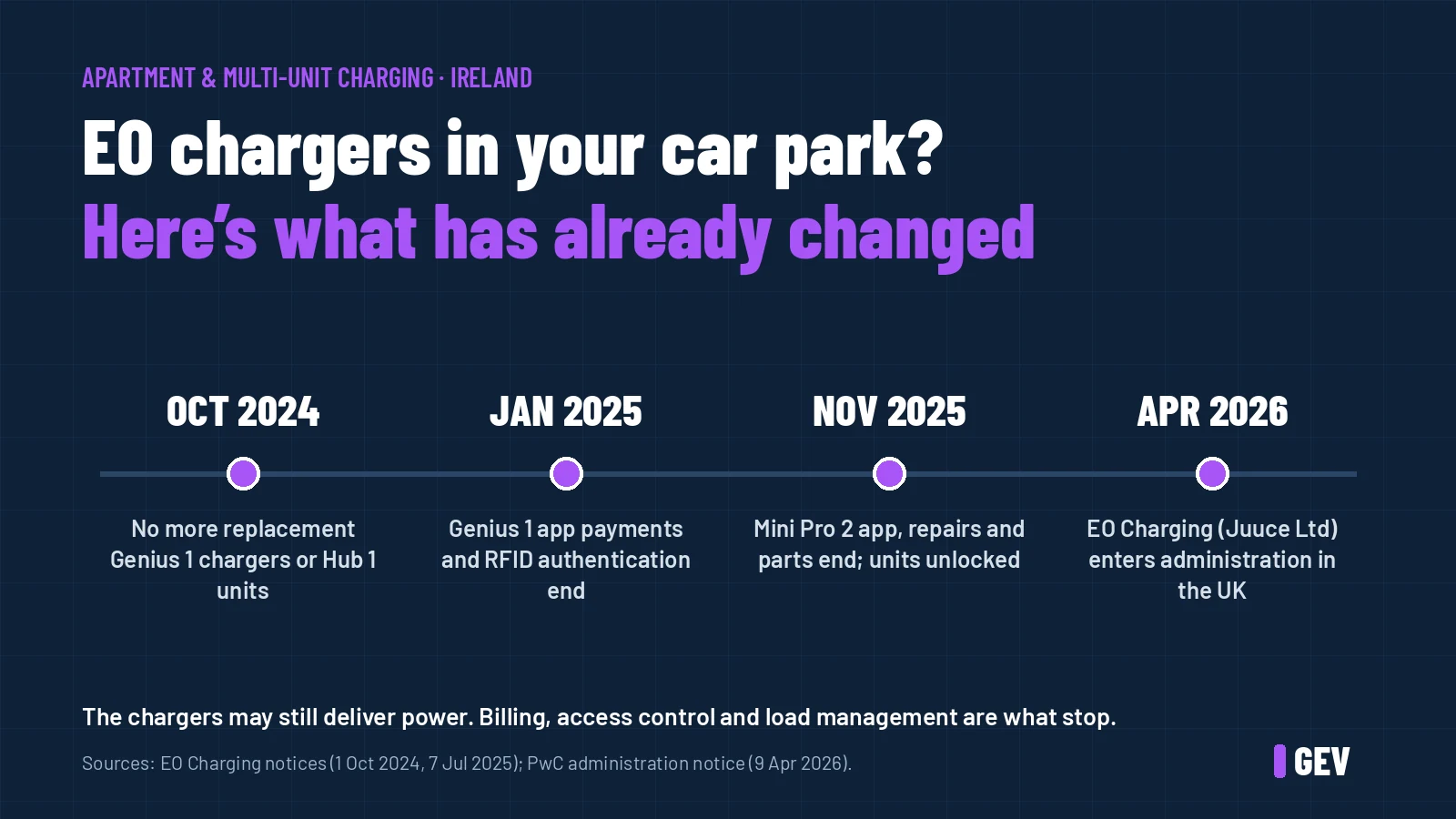
If your development’s chargers carry the EO logo, assume the system behind them needs a plan. EO Charging stopped supplying replacement Genius 1 chargers and Hub 1 load-management units in October 2024, switched off app payments and RFID authentication for Genius 1 in January 2025, ended app control and repairs for the EO Mini Pro 2 on 30 November 2025, and entered administration in the UK on 8 April 2026. The chargers may still deliver power, but billing, access control and load management are what an apartment network depends on.
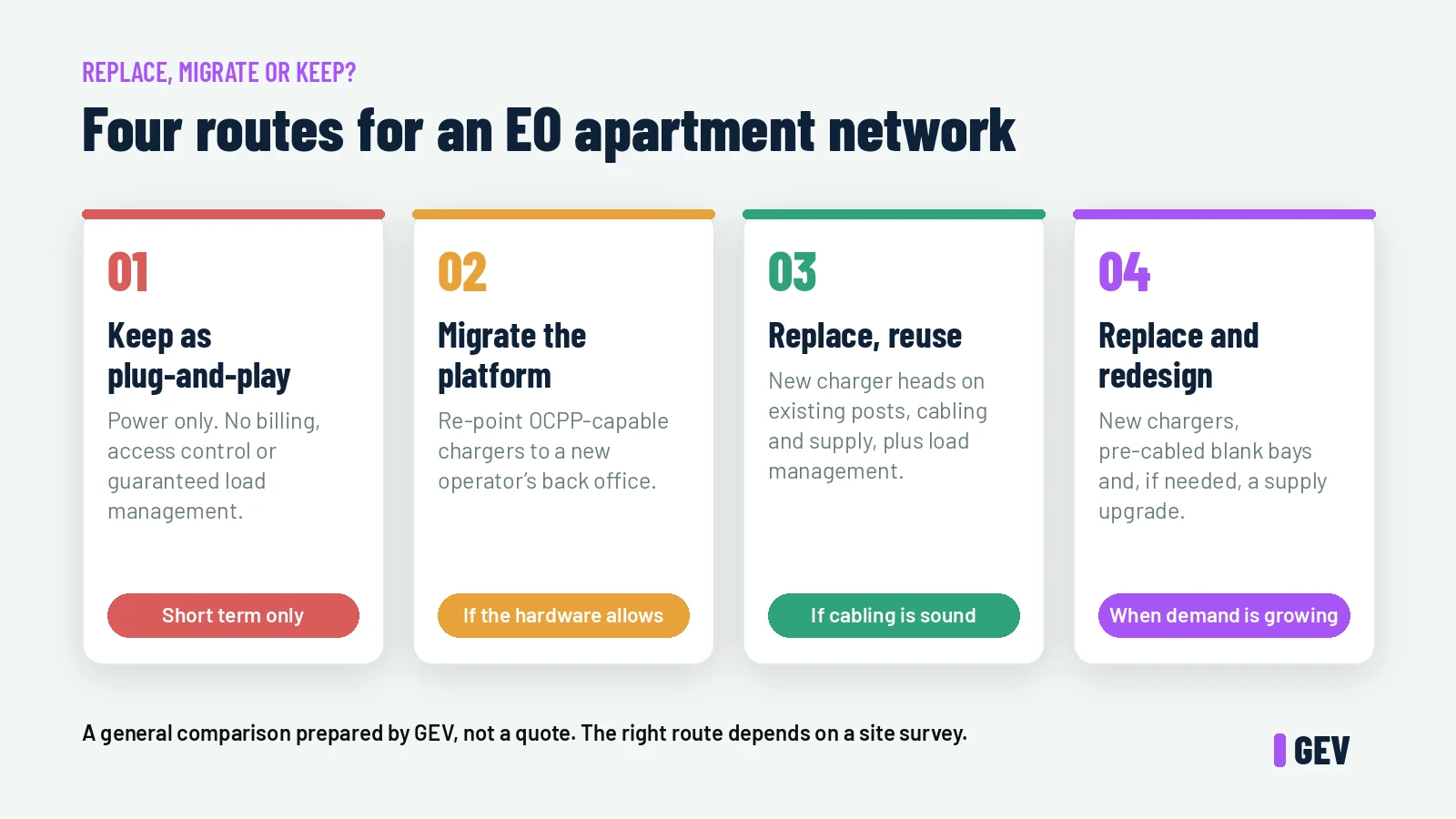
An owners’ management company (OMC) has three realistic routes: move the chargers onto a new back-office platform if the hardware allows, replace the charger heads while reusing posts, cabling and supply, or replace and redesign the network so it can grow. Leaving EO units as unmanaged “plug and play” sockets on a shared landlord supply is rarely safe long term. And with the SEAI apartment grant fully committed for 2026, budget without assuming grant support.
Below: what changed, how to check your site, how the options compare and how to switch without leaving residents stranded.
What happened to EO Charging, and why does it matter for Irish apartments?
EO was a UK manufacturer whose chargers were installed in Irish homes and apartment car parks. Its changes arrived in stages, each removing something a shared network relies on:
- 1 October 2024: EO said it would stop offering replacement Genius 1 chargers and EO Hub 1 units. Existing Genius 1 chargers would keep working as “plug and play” devices, and a working Hub 1 would still manage load, but EO said that capability was “not guaranteed nor permanent” (EO announcement).
- 10 January 2025: payment and RFID authentication through the EO app were discontinued for Genius 1 devices, and EO Cloud 1 began to be phased out in favour of EO Cloud 2, its OCPP platform, with customers offered an upgrade path.
- 30 November 2025: the EO Mini Pro 2 lost app control, smart schedules were cleared, all units were automatically unlocked, and EO stopped providing repairs, spare parts and software updates (EO Mini Pro 2 notice).
- 8 April 2026: Juuce Limited, trading as EO Charging, entered administration with PwC as joint administrators. PwC said 69 of the company’s 93 employees were made redundant and that the administrators were looking to help customers move “to alternative suppliers” (PwC announcement).
- 16 May 2026: Pod, part of EDF, announced it had acquired EO Charging, describing it as a fleet and depot charging business and saying existing EO customers would continue to receive service (Pod announcement).
That deal is focused on UK depot charging. If your development still relies on an EO platform, ask your operator to confirm in writing what support now applies to your site, and for how long.
Irish owners have felt the effects. In a long boards.ie thread on the Mini Pro 2, one poster reports that “alot of installers have moved from EO so hard to get someone to do it”, and others describe warranty disputes passed between the manufacturer and the installer. Those are home chargers, but the lesson carries over: when the platform goes, the people who can support it go too.
How do you know if your development’s chargers are affected?
Walk the car park with whoever holds the original installation file and check:
- Make and model. Note the label on every unit, and any separate hub or control box near the distribution board.
- Who runs the back office. The company that bills residents and supports the OMC is your charge point operator (CPO).
- How residents pay and unlock. If chargers were unlocked by an EO app or EO RFID cards, check that this still works. A unit that no longer authenticates users may be free to anyone who plugs in.
- Whose supply feeds the chargers. If the units run off a landlord supply, unmetered or unbilled charging is paid for by the OMC, and so by every owner through the service charge.
- Load management. Find out whether an EO Hub limits the total current on that supply. If it fails, several cars charging at once could overload the board or trip the supply.
- Connectivity. Note whether chargers connect by Wi-Fi, SIM or cable, and who owns that connection.
If you cannot answer most of these from your own records, that alone is a reason to get a site assessment.
Can existing EO chargers be moved to a new platform?
Sometimes. Many commercial chargers talk to their back office using OCPP (Open Charge Point Protocol), and in principle an OCPP charger can be pointed at a different operator’s platform. EO itself moved customers from Cloud 1 to an OCPP-based Cloud 2. Whether your units can make the same jump depends on the model, its firmware, whether anyone still has configuration access, how it connects, and whether load management depended on EO’s own hub.
Treat migration as something to test, not assume. A good operator will check sample units on site before quoting and tell you plainly if the hardware is locked or not worth maintaining. Where EO has stopped supplying replacement units and parts, every future fault gets harder to fix, even if the charger can be re-pointed today.
Replace, migrate or keep: which option fits your development?
The right route depends on the age of the hardware, the state of the supply and how many residents will want to charge in the next few years.
| Option | What it involves | When it can make sense | What to watch |
|---|---|---|---|
| Keep as plug-and-play | Chargers deliver power with no app, billing or access control | Short term only, or a single unit on a resident’s own metered supply | On a landlord supply the OMC pays for every kWh; no load-management guarantee; no parts |
| Migrate to a new platform | Re-point OCPP-capable units to a new operator’s back office | Hardware is recent, supports OCPP and can be reconfigured | Firmware and configuration access, connectivity, hub dependency, future spare parts |
| Replace chargers, reuse infrastructure | Swap the charger heads; keep posts, cabling, comms and supply where sound; add load management | Cabling and supply are in good order but the chargers are unsupported | Compatibility of existing posts and cables; site disruption; a clean billing cut-over |
| Replace and redesign | New chargers plus pre-cabled “blank” bays, load management and, if needed, a supply upgrade | Demand is growing, the layout is inconsistent or the supply is close to its limit | Higher upfront cost; ESB lead times for any MIC upgrade; grant timing |
What does a replacement look like in practice?
Two GEV projects show what a replacement can look like.
At Clongriffin in Dublin 13, the EO platform was being discontinued, which would have left the chargers unable to bill residents for their electricity. GEV replaced the EO units with six Easee 22kW chargers per building, converted the remaining points to consistent blanks, and added dynamic load and phase management at each building’s distribution board. The work was sequenced block by block so residents kept charging throughout, and RFID was kept for weak-signal areas alongside the GEVTopUP app.
At Halliday House & Cheevers Court, the issue was an ageing set of chargers spread across several distribution boards, with no proper load management. GEV replaced 16 chargers with Garo Entity Pro 22kW units, reused existing posts, cabling and comms where possible, and fitted load-interface units and current transformers across all six boards feeding the chargers. The management company now has monitoring, control and reporting across the whole system.
Connectivity catches people out. At Neptune Apartments and Smithfield Market, GEV added 4G routers, Wi-Fi antennas and cell boosters so the app works in the car park, three floors underground at Smithfield.
Will the SEAI apartment charging grant pay to replace EO chargers?
Do not plan on it for 2026. SEAI’s apartment charging grant page says the scheme “is now fully committed for 2026” and it cannot accept any more applications for projects this year.
Even when the scheme is open, a straight like-for-like swap may not qualify. SEAI’s Application Guide with Terms & Conditions (Ver. 01.1, 12 February 2026) lists as ineligible “the cost of measures completed in facilities which have previously received an SEAI grant for the same measure” and “the cost of remedying defective works and installations undertaken previously by others”. The same guide says a development can make further applications for upgrades or additional chargers, within a cumulative cap of the lower of €5,000 per dwelling or €100,000, and that “all existing and new charger network installations used to power EVs must be fitted with dynamic load management capabilities.”
In practice: budget for replacing unsupported chargers from the OMC’s own funds or sinking fund. If you are also expanding the network, ask your operator which parts might suit a future grant round before anything is installed, because costs incurred before a letter of offer are ineligible.
How do you replace chargers without leaving residents unable to charge?
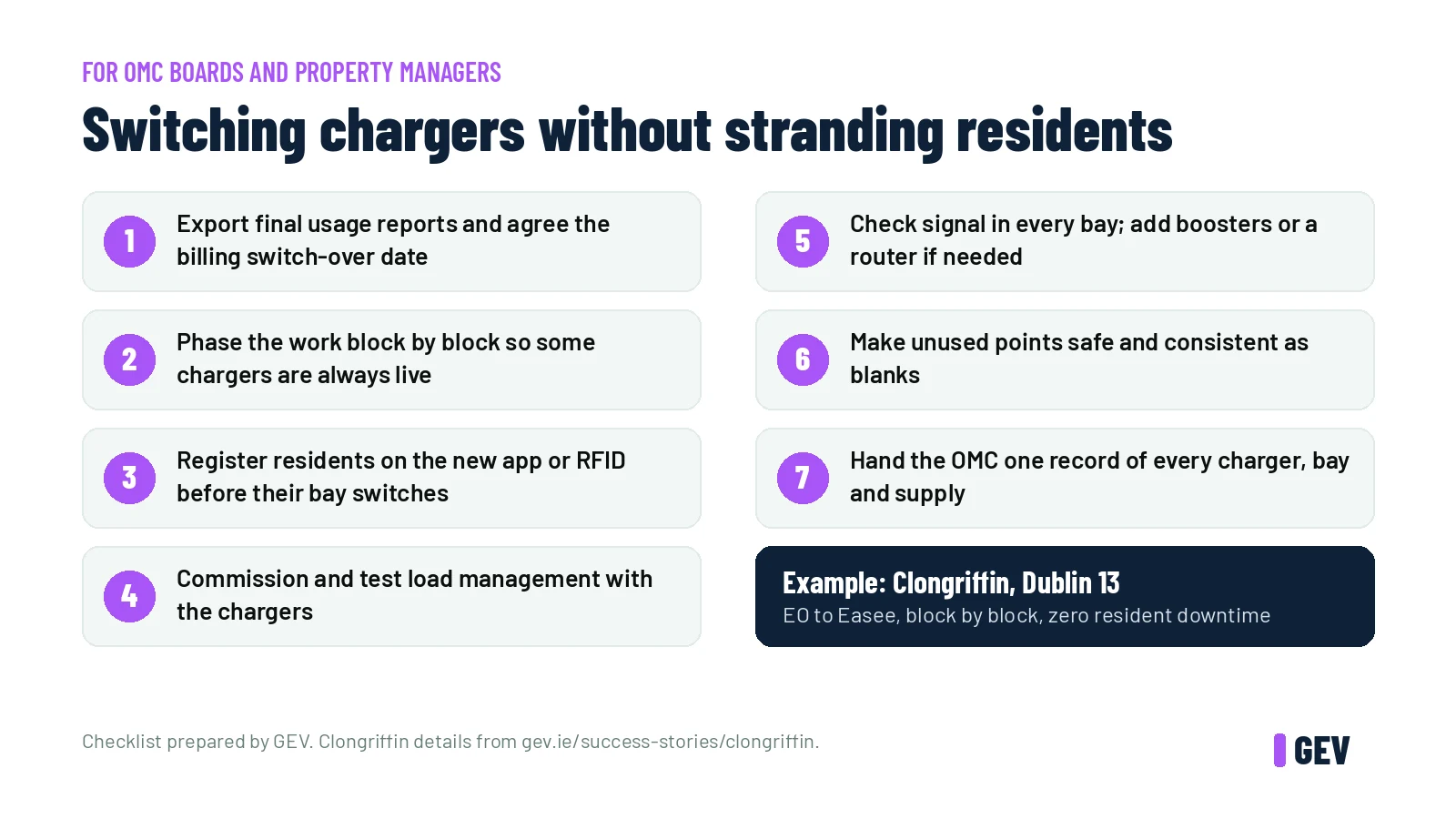
Most of the risk sits in the cut-over, not the installation. Plan these steps with your operator:
- Agree the date billing moves to the new platform, and export final usage reports from the old one first if you still can.
- Phase the work block by block or level by level, so some chargers are always live. Clongriffin was done this way, mid-winter.
- Register residents on the new app or issue new RFID cards before their bay is switched over, and tell them the date in writing.
- Commission load management at the same time as the chargers, not afterwards, and test it with several cars charging at once.
- Check signal in every bay and add boosters or a router where needed.
- Make unused points safe and consistent, as blanks or capped outlets, so the car park is easy to manage and to expand.
- Hand over a single record of every charger, its bay, its supply and its serial number to the OMC.
What should the OMC board ask before choosing an operator?
Replacing EO is a chance to avoid the next stranded platform. Ask any operator:
- Are the chargers you propose OCPP-compliant, and can we move them to another operator later if we choose?
- Who owns the chargers, the data and the residents’ accounts?
- How do residents pay, what does the OMC pay each year, and who handles arrears and support calls?
- How is load managed on our supply, and what happens if demand grows beyond it?
For future grant applications, SEAI only considers applications that list a CPO from its register of charge point operators. GEV is listed there under its legal name, GlenEV Technologies Ltd.
What to do next
If your chargers are EO units, or you are not sure, start with a clear picture of the hardware, supply and billing. Request a free site assessment and GEV will survey the car park, test whether existing units can be kept or re-pointed, and set out a phased plan to replace what cannot, with load management and billing through GEVTopUP. Prefer to talk first? Book a free consultation. You can also see more of our apartment and multi-unit projects or read about our residential charging service.
FAQs
Do EO chargers still work?
Many still deliver power. EO said Genius 1 chargers would continue as “plug and play” devices and that Mini Pro 2 units would work as basic plug-and-charge chargers after 30 November 2025. What stops is the smart side: app control, payments, RFID authentication, schedules and, for older hubs, guaranteed load management.
Is it safe to leave EO chargers unlocked in a shared car park?
It needs checking site by site. On a landlord supply, unlocked chargers can mean the OMC pays for residents’ charging with no way to recover it, and without working load management several cars charging together could overload the supply.
Can we keep our existing posts and cabling?
Often, if they are sound and compatible. At Halliday House & Cheevers Court, GEV reused existing posts, cabling and comms where possible to keep the cost down. A survey confirms what can stay.
Will the SEAI grant cover replacing EO chargers?
Not in 2026: SEAI says the scheme is fully committed for this year. Under the published guide, measures that already received an SEAI grant, and remedying earlier defective work, are ineligible. Expansion may differ in a future round.
How long does a replacement take?
It depends on the number of chargers, the supply and whether ESB work is needed. Phasing lets residents keep charging while each block is done; ask for a written programme after the survey.
What happens to residents who bought their own EO charger for their bay?
Agree a policy before work starts: does the OMC replace those units as part of the network, or do residents replace their own? Electric Ireland’s reply quoted in the boards.ie thread notes that anyone who previously claimed an SEAI home charger grant cannot claim it again, so be clear about who pays.