GEV blog
Grants for EV chargers at your office or fleet depot in Ireland: what your business can actually claim in 2026
10 min read
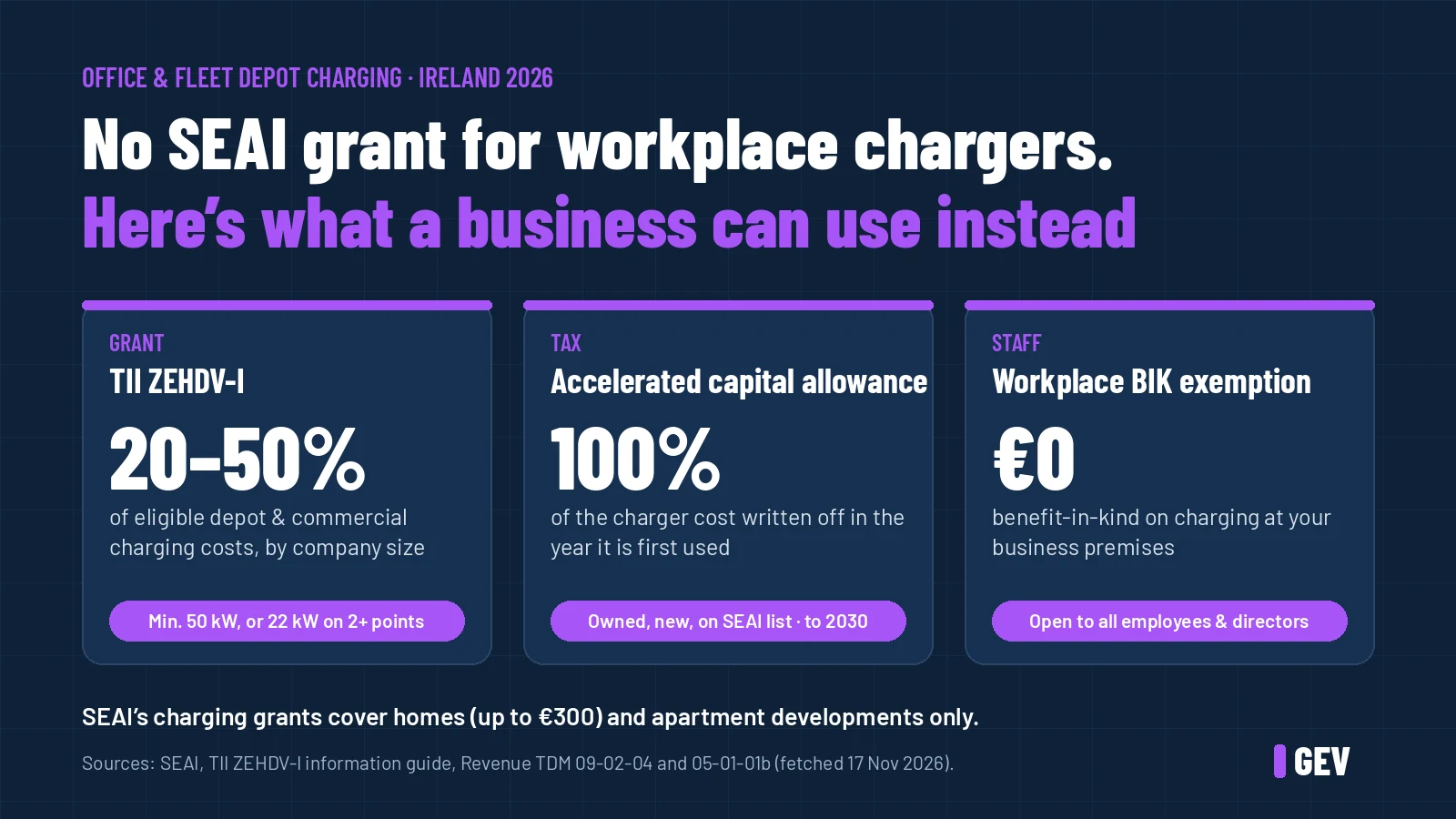
Short answer: there is no general SEAI grant for chargers in an office or business car park. SEAI’s charging grants cover homes and apartments. For a business, the money usually comes from three other places: the ZEHDV-I grant from Transport Infrastructure Ireland (TII) for depot and commercial charging that meets its power rules, a 100% accelerated capital allowance on qualifying chargers you own, and the benefit-in-kind exemption that lets staff charge at work without a tax bill.
Each one has conditions that are easy to trip over, and the most expensive mistake is the simplest: ordering chargers before the grant letter arrives. Below is what each support covers, who qualifies, and the order to do things in so you do not lose funding.
Which support fits your site?
Start with where the chargers will go and who will use them.
| Support | Who it is for | What it helps with | Key condition |
|---|---|---|---|
| SEAI home charger grant | Individual homeowners | Up to €300 towards a home charger | Home use; not an office or depot car park |
| SEAI apartment charging grant | Apartment residents, owners and OMCs | Shared charging in multi-unit developments | Apartment schemes only; not a workplace grant |
| TII ZEHDV-I grant | Any enterprise, including sole traders | 20% to 50% of eligible charging infrastructure costs, by company size | At least 50 kW on one point, or 22 kW on each of two or more points; no costs before the grant letter |
| Accelerated capital allowance (ACA) | Companies and unincorporated businesses | 100% of the charger cost written off in the year first used | New, on SEAI’s list, owned (not leased); runs to 31 Dec 2030 |
| BIK exemption for workplace charging | Employers and their staff | No benefit-in-kind charge on charging at the business premises | Must be available to all employees and directors |
Is there an SEAI grant for EV chargers at a workplace?
Not at the moment. SEAI’s EV charging grants page lists two charging grants, both administered for Zero Emission Vehicles Ireland (ZEVI): the home charger grant, worth up to €300 towards a home charger, and the apartment charging grant for residents, owners and management companies of multi-unit developments. Neither covers an office car park or a depot.
If a quote for a workplace says “grant-assisted”, ask which scheme, who the applicant is and where its rules say your site qualifies.
Mixed-use building with apartments above the offices? The residential side may qualify differently; see GEV’s residential charging page.
What does the ZEHDV-I depot charging grant cover?
The Zero-Emission Heavy Duty Vehicle – Infrastructure grant (ZEHDV-I) is funded by the Department of Transport and run by TII. When it was expanded, the Minister announced that businesses could access funding for recharging stations at depots, logistics hubs and commercial premises, and that the scheme is open to all businesses, including those that do not yet own a zero-emission heavy-duty vehicle. TII’s information guide describes the heavy-duty sector it targets as including vans, trucks, buses and coaches.
Who qualifies
Any private, public or commercial enterprise can apply, including sole traders. Chargers outside a port fall under ZEHDV-I and can be kept for your own private use, opened to the public, or both. Inside an inland or maritime port, the separate ZEHDV-IP scheme applies and the chargers must be publicly accessible.
The power rule
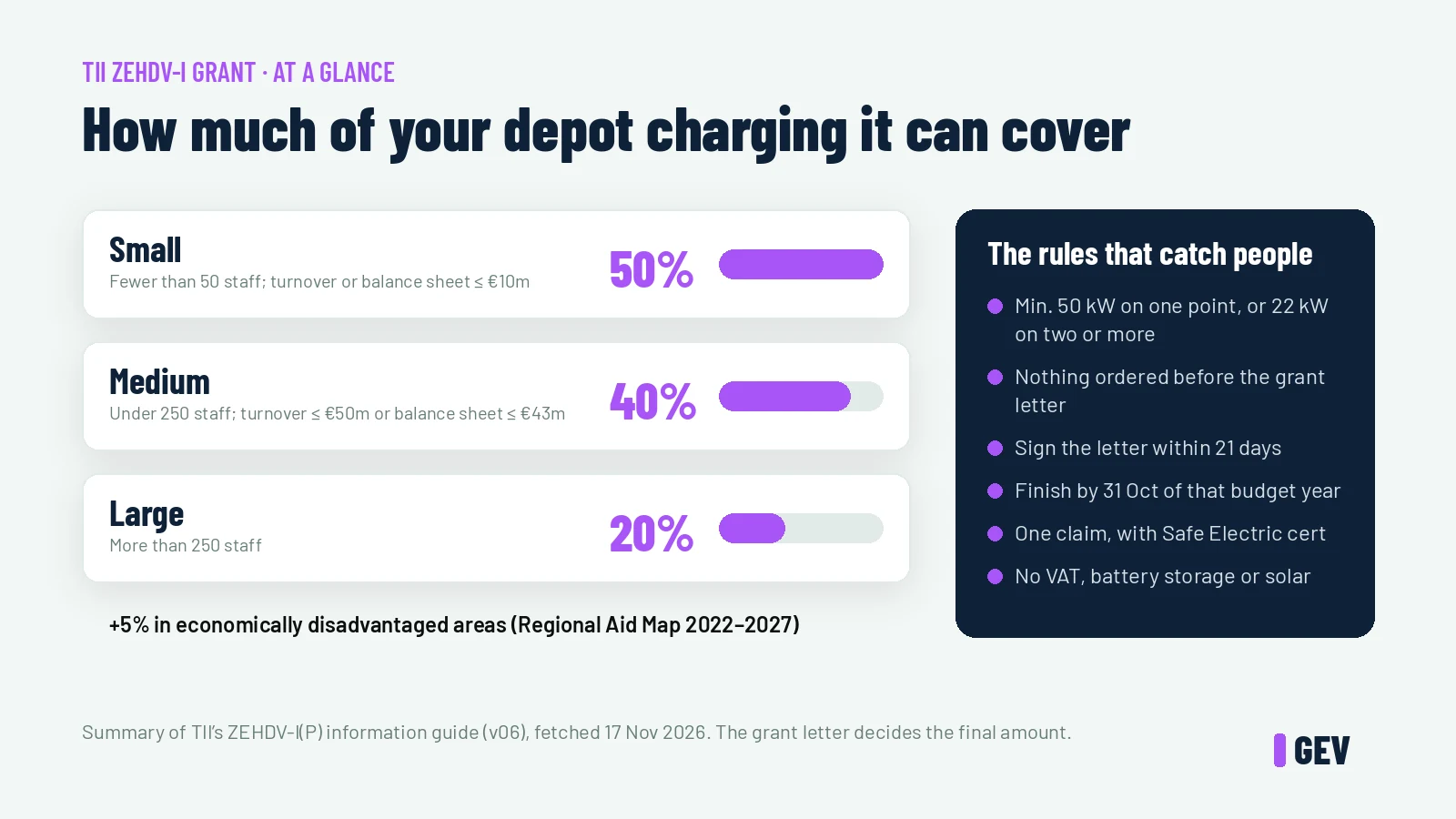
The infrastructure needs at least 50 kW on a single charging point, or 22 kW per point where there are two or more points, with at least 44 kW available across a pair of 22 kW points. A single 7 kW wallbox will not qualify. A pair of 22 kW AC chargers can, which matters for depots where vans sit overnight and do not need rapid DC charging.
How much it pays
The grant is a percentage of eligible costs, set by company size under EU state aid rules: 50% for small enterprises (fewer than 50 staff and turnover or balance sheet of €10 million or less), 40% for medium (fewer than 250 staff) and 20% for large. Sites in an economically disadvantaged area, as set out in the Regional Aid Map for Ireland 2022–2027, can get an extra 5%. The guide caps grants at €200,000 per applicant and its affiliates in a budget year.
Example only, using those rates: a small company with €60,000 of eligible costs, excluding VAT, outside a disadvantaged area could be offered up to 50%, or €30,000. The real figure is whatever the grant letter says.
What it pays for, and what it does not
- Covered: the chargers and related equipment, electrical upgrades needed to connect them (including cables and transformers), civil works such as trenching and ground reinstatement, planning fees and development contributions, and installation.
- Not covered: anything spent on or before the date of the grant letter, VAT, running costs, professional fees for preparing the application, finance costs, and any cost already funded by another grant scheme.
- Battery storage and on-site generation are not eligible. TII’s guide points businesses wanting solar to SEAI’s separate non-domestic microgen grant.
How do you apply without losing the grant?
The order of steps matters more than the paperwork. Under TII’s information guide, the process runs like this:
- Get the site surveyed and costed first, including any ESB Networks work, so the application reflects the real scope.
- Apply on TII’s application form, emailed to the scheme operator. Applications are considered on a first-received basis.
- Wait for the grant letter. You then have 21 days to sign and return it, or the application is cancelled.
- Only now order and install. Equipment already ordered, purchased or installed is not eligible.
- Finish by 31 October of the budget year in which you accepted the letter. If ESB Networks has not made the grid connection operational within six months of signing, you can ask for a single 12-month extension within five working days of finding out.
- Claim once. There is one drawdown per application, supported by tax clearance, ESB Networks and contractor invoices, a Safe Electric completion certificate, a contractor declaration of works and photos. Anything left out of the claim is dropped from the grant.
Timing: the guide says each year’s scheme opens on 1 November for the following budget year and takes applications until 30 September, or earlier if the money runs out. Funding is set by Government each year, so confirm with TII that the current round is open and funded before you plan around it.
Can you write off the chargers against tax instead?
For many offices, this is the bigger lever. Under the accelerated capital allowance scheme for energy-efficient equipment, a business can claim 100% of the capital cost of qualifying equipment in the year it is first used in the trade, rather than over the normal eight years (Revenue TDM 09-02-04). Section 26 of the Finance Act 2025 extended the scheme to 31 December 2030, which Revenue confirmed in eBrief No. 028/26.
EV charging equipment sits in SEAI’s Electric and Alternative Fuel Vehicles category. The conditions:
- The charger must be new and on SEAI’s list of energy-efficient equipment (the Triple E register) during the period you claim.
- The business must own it. Leased, let or hired equipment does not qualify, so this affects whether you buy chargers outright or take them on a lease or subscription.
- The minimum spend for the category is €1,000.
- No prior approval is needed. You claim it on your CT1 or Form 11 under normal self-assessment.
The allowance brings tax relief forward; it does not cut the upfront cost. Whether it can be combined with a ZEHDV-I grant on the same chargers is a question for your accountant.
Do staff pay benefit in kind for charging at the office?
No, provided you set it up correctly. Revenue’s guidance on employer-provided vehicles (section 10.1) explains that section 118(5H)(a) of the Taxes Consolidation Act exempts charging facilities on an employer’s business premises from BIK, but only where the facility is available to all employees and directors.
In practice, a charger reserved for the managing director’s car is a problem; shared chargers that anyone on staff can book are not. Many businesses also want different prices for fleet vehicles, staff cars and visitors. That is a billing set-up question rather than a hardware one, and it is what GEV’s office charging service handles: drivers are recognised, fleet and staff tariffs are kept separate, and the cost is reported back to finance.
Home charging for company cars follows different rules; see GEV’s fleet home charging page and the Vhi case study.
Will your electricity supply cope?
This is where most office and depot projects stall. Every business connection has a Maximum Import Capacity (MIC) agreed with ESB Networks, and a few 22 kW chargers can use up the headroom quickly in a building that already runs heating, cooling and IT.
According to ESB Networks, increasing a business MIC means applying online, receiving a quotation and connection agreement, possibly upgrading your main switchboard, and, where the local network needs reinforcing, paying a capital contribution or providing a site for a new substation. In constrained areas, ESB Networks may offer a flexible demand connection after you apply, which can let a business increase its MIC sooner.
There are two ways to keep the bill down. Smart load management shares the available power across chargers so you need less new capacity; GEV’s energy management service also uses battery and flywheel storage. Second, if you are applying for ZEHDV-I, upgrades to cables and transformers needed to connect the chargers are listed as eligible costs, while battery storage is not. Do the supply study before you fix the charger count.
What does this look like in practice?
In GEV’s projects, the supply usually decides the project, not the chargers.
- Smithfield Market, Dublin 7: a mixed-use building with a public pay car park, apartments, a hotel and commercial units. GEV installed a 140 kVA dedicated EV supply serving 17 chargers across three underground levels, switching from public use by day to residents at night.
- Seabrook Manor, Portmarnock: both ESB substations serving the car park were at capacity. GEV applied for a new connection and coordinated a substation upgrade before any chargers went in, then cabled 21 bays.
- The Casino, Malahide: an MIC increase coordinated with ESB so 12 smart 22 kW chargers can run at full power.
Seabrook Manor and The Casino are apartment schemes, but the supply problem is identical on an office campus or a depot. For fleet sites, GEV’s depot charging service covers supplies from 22 kW to 350 kW, and éXō Fleets tracks energy, vehicles and depots in one place. More projects are on the success stories page.
A 6-step funding checklist before you order chargers
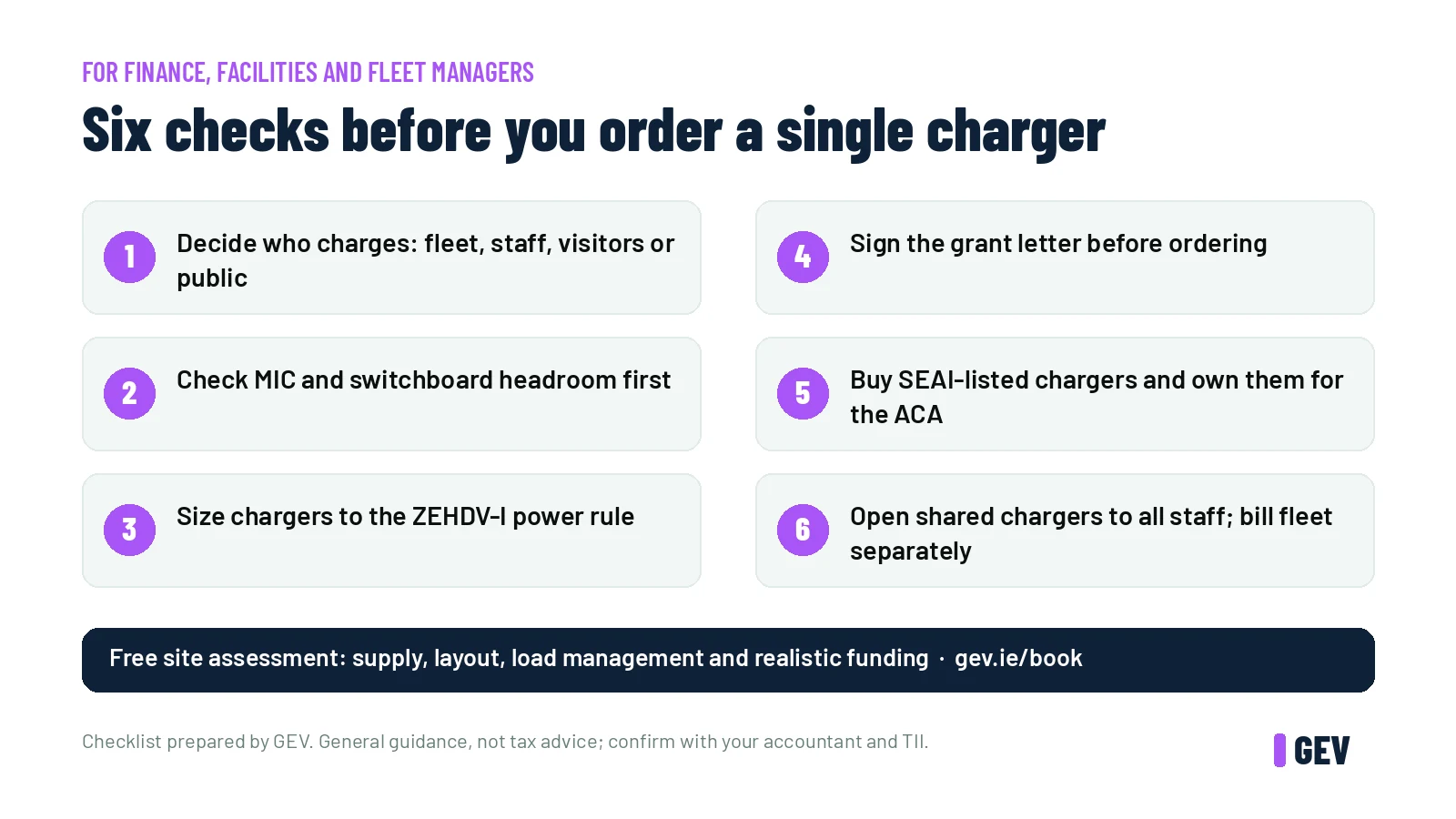
- Decide who will charge: fleet vans, staff cars, visitors or the public. That shapes the power you need and whether the BIK exemption applies.
- Check your MIC and switchboard headroom before you settle on a number of chargers.
- Size the chargers against the ZEHDV-I power rule (50 kW, or 22 kW on two or more points) if you want that grant.
- Apply for ZEHDV-I and sign the grant letter before ordering anything.
- Buy chargers that are on SEAI’s Triple E list and keep them owned by the business if you want the ACA.
- Make shared chargers available to all staff and directors, and keep fleet and staff billing separate.
What to do next
The first job is a proper look at your supply, your bays and how your vehicles are used. GEV does this as a free site assessment: we check your MIC and switchboard, model the charger layout and load management, and tell you which supports are realistic for your site before you spend anything.
FAQs
Is there an SEAI grant for workplace EV chargers in Ireland?
No. SEAI’s charging grants cover home chargers and apartment developments. For business sites, the relevant supports are TII’s ZEHDV-I grant (if your chargers meet its power rules), the accelerated capital allowance and the BIK exemption for workplace charging.
Can a company with electric vans use the ZEHDV-I grant?
Potentially. TII’s guide describes the heavy-duty sector it targets as including vans, trucks, buses and coaches, and the scheme is open to businesses that do not yet own a zero-emission heavy-duty vehicle. The chargers must meet the 50 kW, or two-or-more 22 kW points, rule. Confirm your project with the scheme operator before you apply.
Can we install the chargers now and claim the grant later?
No. Infrastructure already ordered, purchased or installed is not eligible, and costs incurred on or before the date of the grant letter are excluded.
Do leased chargers qualify for the accelerated capital allowance?
No. Revenue says the equipment must be owned by the business; leased, let or hired equipment does not qualify. It must also be new and on SEAI’s list.
Is free charging at work a taxable benefit for employees?
Not if the charging facility is on the business premises and available to all employees and directors. Revenue sets this out in section 10.1 of its guidance on employer-provided vehicles.
Does ZEHDV-I pay for battery storage or solar panels?
No. On-site generation and battery storage are not eligible. TII points businesses towards SEAI’s non-domestic microgen grant for solar PV.