GEV blog
Load management or an MIC upgrade? How to fit more EV chargers on your building’s ESB supply
10 min read
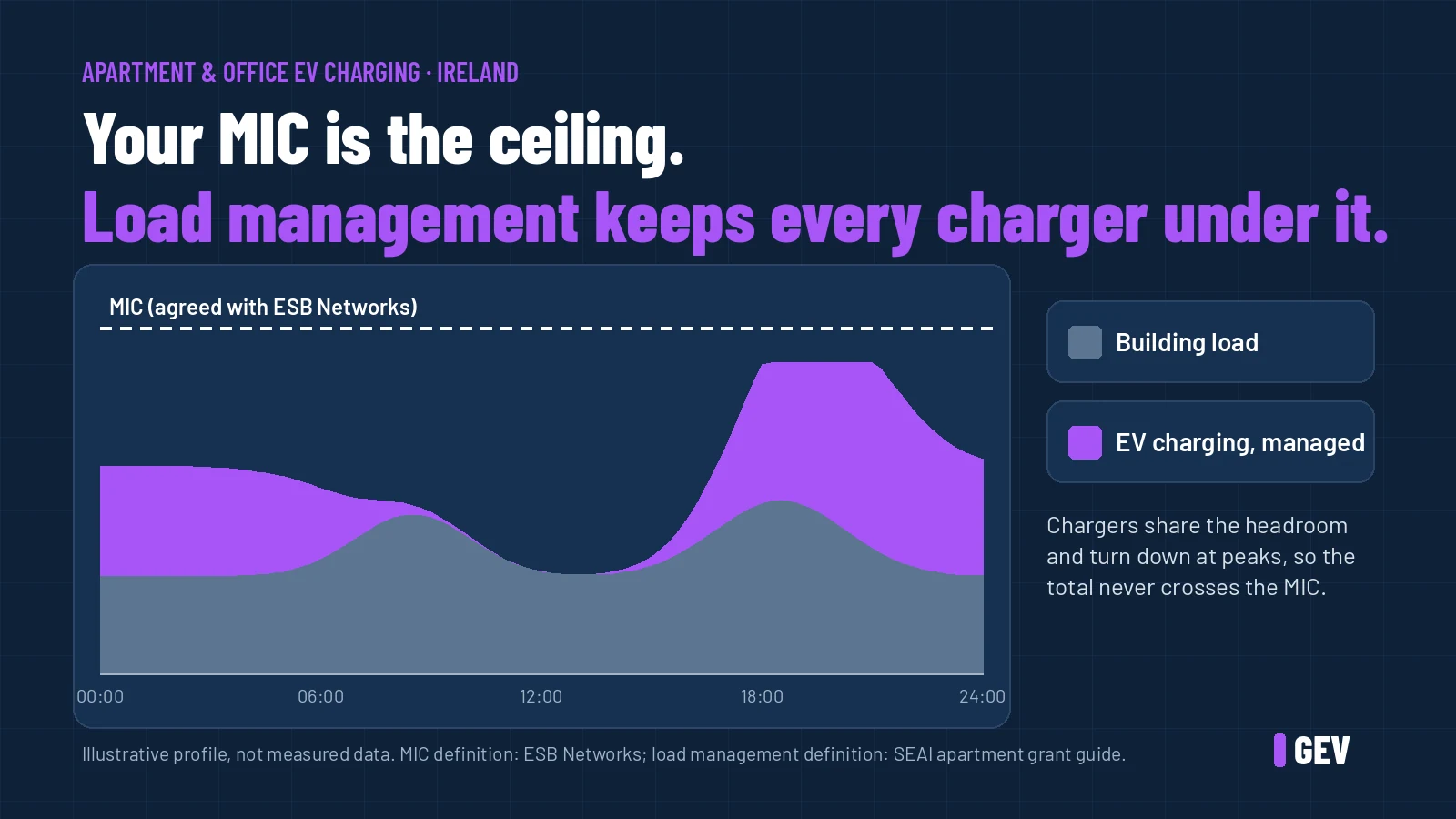
Short answer: every building’s electricity connection has a Maximum Import Capacity (MIC), the most power it is allowed to draw from ESB Networks under its connection agreement. Dynamic load management shares whatever is left of that capacity across your chargers and turns them down when the building is busy, so the total never goes over the limit. That is how several of the GEV projects below started charging on the supply they already had. When the number of cars outgrows the supply, there are three ways forward: an MIC increase, a separate ESB supply just for the chargers, or, in constrained areas, a flexible demand connection.
Load management is not optional for apartment schemes using the SEAI grant: the scheme guide requires it on every ESB metered connection used to charge EVs. Below: how it works, when it stops being enough, and what an upgrade costs and takes.
What is MIC, and why does it limit how many chargers you can install?
MIC is the maximum kVA your site may import, written into your connection agreement, and ESB Networks designs its network around it. Every charger you add eats into the headroom between what the building already uses and that limit.
ESB Networks says it designs its network to suit the agreed MIC, and its standard connection for an average home is 12 kVA. A three-phase 22 kW charger, the size GEV fits in most of the car parks below, draws up to 3 x 32 amps, according to SEAI. A few of those running flat out can use up the spare capacity on a supply that already powers common areas.
In apartment developments, SEAI notes that a charge point may need to connect to the landlord supply rather than an apartment’s own. ESB Networks treats supplies that serve the common or communal areas of residential developments as commercial connections, so the business rules on MIC apply.
ESB Networks’ code of practice gives the same two choices even for one home charger: control equipment so the MIC is not breached, or an MIC increase. A shared car park faces that decision at scale.
How does dynamic load management let you add chargers without more power?
A central controller measures the whole building’s consumption and each charger’s draw, then adjusts the power going to each car so the connection’s MIC is never exceeded. Cars still charge; they share the available power instead of all taking the maximum at once.
That is the definition SEAI uses in its apartment grant guide, which lists the centralised controller, CT clamps, monitoring and communications equipment as an eligible cost. Phase management goes a step further by spreading load across all three phases of a supply. GEV’s energy management service combines dynamic load and phase management with battery and flywheel storage and real-time dashboards.
It works because most cars in a residential or workplace car park are parked for hours. SEAI says a 7 kW AC charge can add about 100 km in roughly two hours, and that many cars can only accept a single-phase charge even at a 22 kW charge point.
Load management can also tidy up older systems. At Halliday House and Cheevers Court, GEV replaced 16 chargers and fitted load-interface units and CTs across the six distribution boards that feed them.
Is load management required for the SEAI apartment charging grant?
Yes. SEAI’s guide says all existing and new charger networks must be fitted with dynamic load management, and its terms require it for every ESB metered connection used to charge EVs.
SEAI also expects the charge point operator (CPO) to plan for growth. Its CPO registration page says operators must advise on connection capacities with intelligent load management to keep connection costs and standing charges down. Where an ESB connection or upgrade is needed, the guide treats its cost as eligible, capped at the ESB Networks Statement of Charges in force at the time.
Two timing points matter. SEAI says the apartment scheme is fully committed for 2026, so this is a good time to do the supply study for the next round (see our guide to the 2026 grant position). And developments that notified commencement from 10 March 2021 are excluded, because building regulations already require EV infrastructure in them. Grant rules change, so confirm the current terms with SEAI before you commit.
When do you need an MIC increase or a new ESB supply instead?
You need more capacity when, even with load management, the power left over cannot charge the cars you expect at a speed that works for them. The table compares the options.
| Option | What it is | When it fits | What to expect |
|---|---|---|---|
| Dynamic load management on the existing supply | Chargers share the spare capacity and throttle back at peaks | Spare headroom exists and cars park for long periods | Required for SEAI-funded apartment networks; no ESB application |
| MIC increase | ESB Networks raises the capacity on your existing connection | Demand will outgrow the headroom; supply can be upgraded | Quote and connection agreement; possible switchboard upgrade, network contribution or substation site |
| New dedicated supply for EV charging | A separate metered connection and EV distribution board | Landlord supply is full or split across several cores | New connection application; ESB aims for 60 business days for a small commercial connection |
| Flexible demand connection | Extra capacity that must be reduced to your firm MIC when ESB instructs | Constrained areas where firm capacity is not yet available | Offered by ESB after a standard application; temporary until the network is reinforced |
The ESB Networks process for an increase is: apply online, receive a quotation and connection agreement, check whether your main switchboard needs upgrading, pay, return the signed agreement, then ESB carries out the work. If the local network needs reinforcing, a capital contribution is added to the quote. A larger transformer can mean building a new substation, and you must provide the site.
Supply problems are often what stalls an apartment project. At Seabrook Manor both ESB substations were already at maximum capacity, so GEV applied for a new connection and coordinated a substation upgrade before fitting 10 live chargers and 11 pre-cabled blanks. At Collegefort and Collegewood an ESB substation upgrade unlocked 17 chargers across three car parks.
How much does an ESB MIC increase cost?
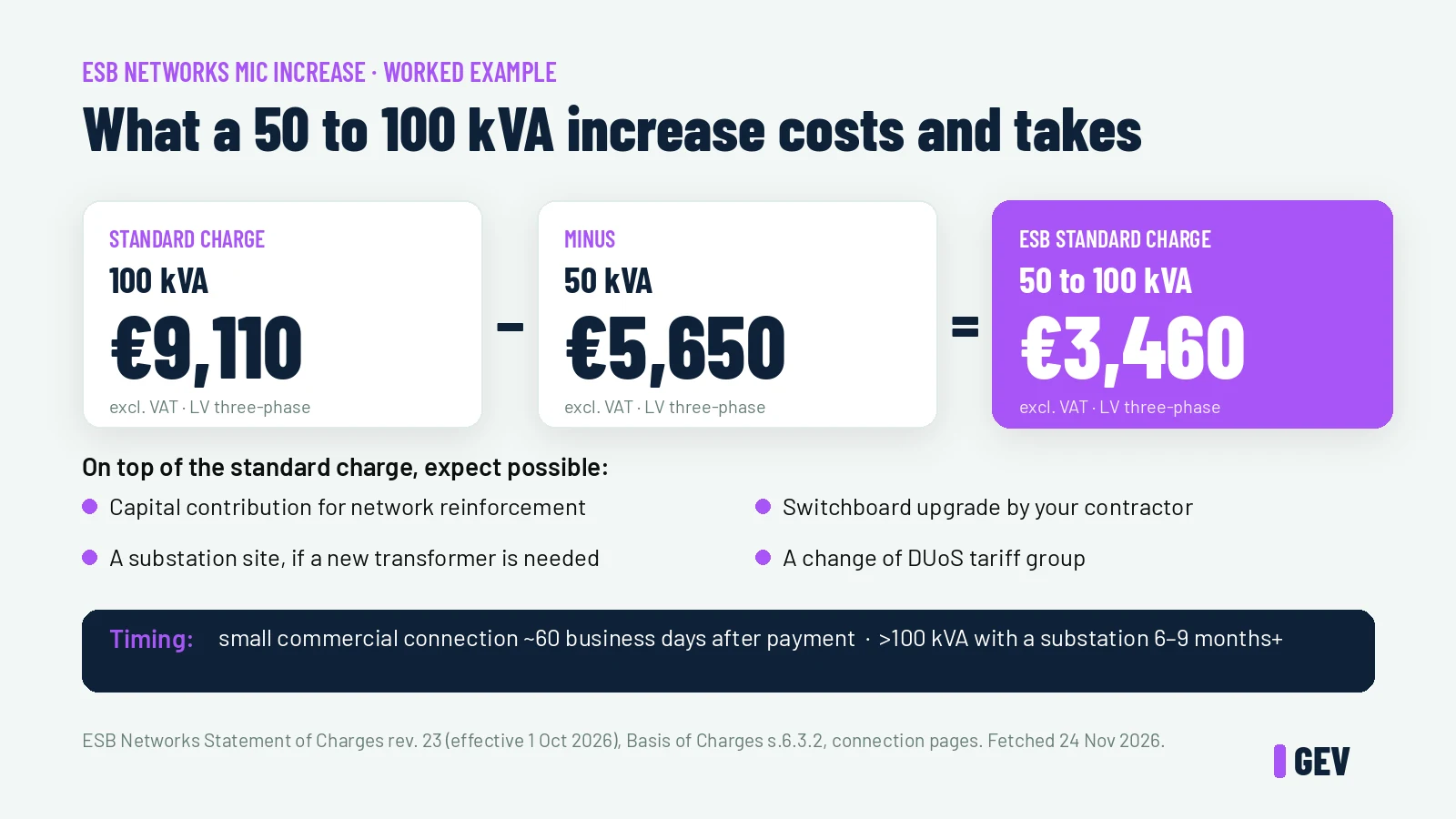
ESB Networks charges the standard charge for the new capacity minus the standard charge for your existing capacity, plus any network reinforcement it needs. The standard charges are set out in its CRU-approved Statement of Charges.
Under the Basis of Charges ESB Networks links from its MIC page, an increase costs the difference between the two standard charges. The current Statement of Charges (revision 23, effective 1 October 2026) lists €5,650 for a 50 kVA low-voltage three-phase connection and €9,110 for 100 kVA, excluding VAT. On those figures, a 50 to 100 kVA increase has a standard charge of €3,460 plus VAT.
That is the ESB part only. The quotation can add a capital contribution for network reinforcement, and switchboard work by your contractor comes on top. ESB Networks also notes a bigger MIC may change your DUoS tariff group and network charges. Rely on the quotation, not the worked figure.
Designing for that step from the start helps. At Bastion Quay in Athlone, GEV put the EV cabinet on a new ESB supply designed to upgrade from 50 kVA to 100 kVA as demand grows, cabled all 51 bays, and has 13 chargers live.
How long does a supply upgrade take?
For a small commercial connection, ESB Networks aims to finish within 60 business days of you accepting the quote and paying. Larger jobs that need a substation take longer.
ESB Networks says loads typically above 100 kVA involving a substation can take six to nine months from application to connection, or longer where capacity is limited. Do the supply study before the charger order.
In constrained areas, ESB Networks offers flexible demand connections so businesses can connect or raise their MIC sooner. You keep your firm MIC but must cut back to it when ESB instructs during constraints; the arrangement becomes firm once the network is reinforced. You cannot apply for one directly; ESB assesses suitability after a standard new connection or MIC increase application.
What changes for offices and workplace car parks?
Workplaces follow the same MIC rules, but ESB Networks asks owners to involve its local office from the design stage, and a separate three-phase business connection for EV charging is possible.
Its code of practice says the premises owner, or a separate entity the owner permits, may apply for a new three-phase business connection for EV charging. For legal minimums, the 2021 building regulations required existing non-residential buildings with more than 20 car parking spaces to have at least one charge point before 1 January 2025. New or majorly renovated non-residential buildings with more than 10 spaces need at least one charge point plus ducting for one in every five spaces.
GEV’s office charging service can run new chargers and existing OCPP-compliant ones, with different tariffs for fleet and staff vehicles. For funding at business premises, see our guide to EV charger grants for offices and depots.
How do real Irish sites handle the supply question?
The pattern: cable the car park once, manage the load, add supply when demand justifies it.
- Addison Park: four 22 kW chargers and four pre-cabled blanks in the visitor bays, fed from the landlord supply with an Easee equaliser managing load and phase.
- Neptune Apartments: six live chargers and eight blanks, balanced across several landlord supply cores.
- Wingfield Apartments: parking on three separate landlord supplies, with a dedicated EV distribution board ready to move to its own ESB supply as demand rises.
- The Casino, Malahide: an MIC increase coordinated with ESB so 12 smart 22 kW chargers run at full power.
- The Pavilion, Dún Laoghaire: a dedicated new ESB supply and EV cabinet kept separate from the building’s electrics, with all 101 bays cabled and 22 chargers live.
- Smithfield Market: a 140 kVA dedicated EV supply serving 17 chargers across three underground levels and four user groups.
What should you check before you decide?
Size the charger plan to the supply, not the other way round.
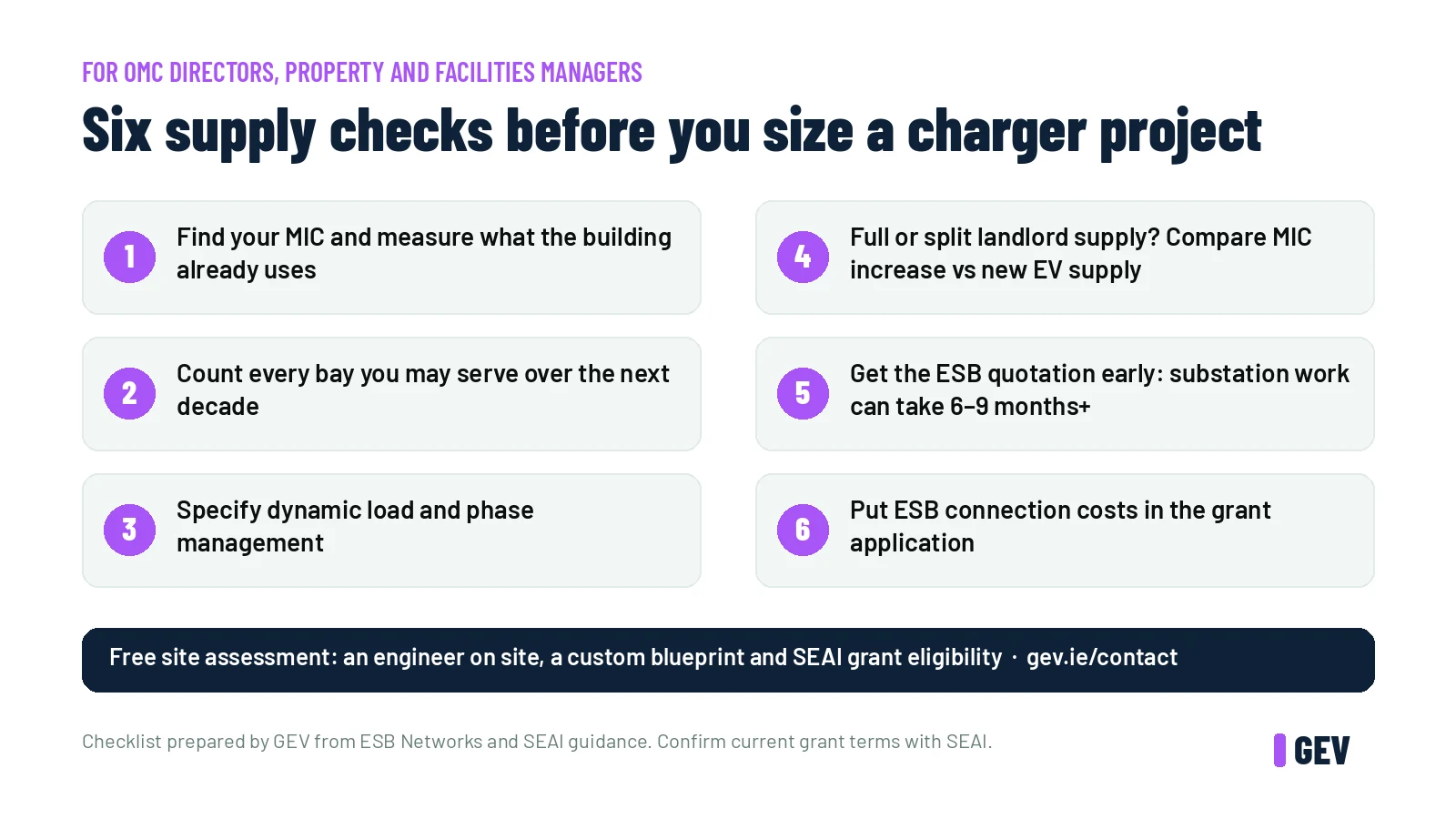
- Find the MIC on your connection agreement and get a registered electrical contractor or engineer to measure how much of it the building already uses.
- Count every bay you may want to serve over the next decade, not just this year’s requests.
- Ask for dynamic load and phase management in every design; on SEAI-funded apartment networks it is mandatory.
- If the landlord supply is full or split, compare an MIC increase with a dedicated EV supply.
- Get the ESB Networks quotation early; substation work can take six to nine months or more.
- Include ESB connection costs in your grant application; SEAI caps them at the Statement of Charges.
Get a free site assessment
GEV surveys your site, models the grant-funded cost and handles the SEAI application end to end, as our success stories show. Our free site assessment sends an engineer to your site and gives you a custom blueprint, including SEAI grant eligibility. Request a free site assessment or book a call to talk through your site capacity and the best charging strategy.
Sources
- ESB Networks — National Code of Practice for Customer Interface, v6.2 (2025)
- ESB Networks — Change business level of supply (MIC)
- ESB Networks — Commercial unit connection
- ESB Networks — Understanding connection capacity
- ESB Networks — Flexible demand connections
- ESB Networks DAC — Statement of Charges, revision 23 (CRU-approved, effective 1 Oct 2026)
- ESB Networks — Basis of Charges for Connection to the Distribution System
- SEAI — Apartment charging grant
- SEAI — EV Apartment Charging Grant Scheme Application Guide with T&Cs, v01.1
- SEAI — EV charge point operators
- SEAI — Easy to charge
- SEAI — Charging an electric vehicle
- S.I. No. 393/2021 — European Union (Energy Performance of Buildings) Regulations 2021
FAQs
Where do I find my building’s MIC?
It is in your connection agreement with ESB Networks, which sets out your MIC along with your DUoS and MCC codes, according to ESB Networks. Your electrical contractor can confirm it and measure how much of it is in use.
Does load management make charging slower?
Only when the building is busy. The controller adjusts each charger’s power so the connection’s MIC is not exceeded, as described in SEAI’s grant guide.
Who pays for an MIC increase?
The customer pays the standard charge difference, plus any capital contribution for network reinforcement shown in the quotation, according to ESB Networks. For apartment schemes, SEAI treats an ESB connection or upgrade as an eligible cost, capped at the Statement of Charges.
Can a resident connect a charger to their own apartment meter?
Usually not in a shared car park. SEAI says a charge point at an apartment complex may need connecting to a landlord supply, and residents of a development that already has a charging network should ask the management company to join that network.
What is a flexible demand connection?
It lets a business in a constrained area connect or increase its MIC sooner, in return for cutting back to its firm MIC when ESB Networks instructs. It is temporary until the network is reinforced and is offered only after a standard application, according to ESB Networks.
Do new apartment buildings need EV infrastructure by law?
Yes. Under S.I. No. 393/2021, new residential buildings with more than 10 car parking spaces, and those undergoing major renovation that includes the car park or electrical infrastructure, must have ducting for every space so charge points can be added later.